Wednesday, January 1, 2014

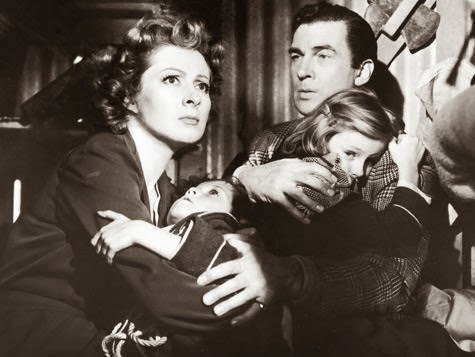
Mrs Miniver (1942)


 It is 1940, and Europe is in the throws of World War II; France is being overrun by Nazis, Germany holds all the cards and Britain stands almost alone in the fight to stop Hitler and his axis of evil. The Allies are doing their best to poke America, but it, pursuing a policy of isolationism, wants European affairs to remain just that. German-born director William Wyler decides he wants to help in the effort to involve the US in this epic war occurring only an ocean away, and thus begins his involvement in the 1942 Academy Award winner for Best Picture, Mrs Miniver.

Mrs Miniver opens on Mrs Kay Miniver (Greer Garson in her Academy Award winning turn), a middle-class woman who is shopping in busy London pre-World War II. She enters a boutique store where she makes quite a fuss about the purchase of what is clearly a very precious and expensive hat. She leaves and boards the train to Balham, where her, her husband (Walter Pidgeon) and her children live. Everything seems fairly pleasant in the world of Mrs Miniver; that is until World War II begins to conquer England, and their lives will be changed forever.

It all seems rather dramatic, and it is; Mrs Miniver is the quintessential World War II propaganda film. It’s easy to see why it felt so important to its time; Presidents pushed to get the film in cinemas quickly, Prime Ministers praised the film’s importance. Contextually, the film works wonderfully; it, both literally and metaphorically, brings Nazi Germany to the doorsteps of the audience in a powerful and persuasive manner. We are forced to reckon with the idea of the world being overrun by a foreign and dangerous force, obliged to acknowledge that the beautiful rose of England may not bloom as it once did before; and I’m sure this felt very real to a Western audience in 1942.

Yet the film feels so outdated; the most nominated director in Academy Award history, William Wyler is as bland a director as they come, and there really is very little extraordinary, or even interesting, about what he does with the material. Its importance seems lost in 1942, back when the director could play on the innate fear of its audience, instead of having to establish the fear himself. The only real strength of the film is found in the performances. Garson is respectable as the virtuous titular character, bringing the requisite charm and warmth to Mrs Miniver in a way only the most able of actors could. What the role requires, she offers in spades, and it’s for that reason the film is watchable. Add to that the brilliant, Oscar-winning performance of Teresa Wright as the equally-lovable and ever-so charismatic Carol Beldon, and the hilariously cutting performance of Dame May Whitty as Carol’s grandmother Lady Beldon, and you get a fairly enjoyable female ensemble. Even the youngest son (who looks sufficiently feminine) Toby (Christopher Severn) is wonderful.

It is wonderful to find a film which was made so as to facilitate the resonance of the war with those at home. The clear focus on the lives of the female characters is indicative of the particular attempt to drive this message home to the common housewife, which is commendable for a film of its time. The unfortunate part is that, try as the film does, the strength of the female characters is laughable by modern standards, and there is even one scene where Mrs Miniver, having proven herself the equal of her husband, is slapped hard on the rear, effectively undoing the work of the writers up until that point. The lack of dimension to all the characters repeatedly undermines the film also, though Wright and Garson do so much to make up for it. Without them, this film would be lost.

Having said all this, Mrs Miniver was a hit in its day, being the biggest film of 1942 and MGM’s greatest earner at the time. The film resounded so well that Roosevelt had parts of the dialogue printed onto leaflets and dropped during the war. It earned twelve Oscar nominations, was the first film to be nominated in all four acting categories and it won in six categories all up. It served its purpose as a propaganda film, effectively summing up the feeling of its time and is a reminder of the horrors which war brings home. And the social discourse which makes its way into the film is fairly powerful, definitely one of the more effective aspects. Yet it is a shame the purpose of Mrs Miniver is so obvious and clear, because the soul of the film remains trapped in the realms of 1942 and cannot move beyond. The next Oscar winner for Best Picture would go on to show how a propaganda film can serve to be so much more…


Saturday, June 15, 2013

Le Passé (The Past)


An anxious Marie (Berenice Bejo) arrives at the airport, picking up her estranged husband Ahmad (Ali Mosaffa) so that they can finalise their divorce. She spots him, a hint of bittersweet acknowledgement adorns her face, she moves closer to him but finds a soundproof wall dividing the pair. No matter; she gestures to another, they get his attention and after a few gestures, they're on their way, running to her car and out of the rain. However, a number of walls remain built up around Marie, and they follow her everywhere she dares to go.

Le Passé (The Past) is Asghar Farhadi's follow-up to the unanimously praised A Separation, a film which claimed almost every Foreign Film award you can imagine in 2011. And knowing he struck a winning formula, Farhadi sticks with what he knows, invoking a number of the same themes in this piece, a brilliantly-told narrative surrounding Marie and the relationships in her life.

Farhadi moves out of his native Iran for this piece, instead setting  the film in France; a change of culture perhapps, but certainly not of the human condition. Loss, change, separation; they are all still pertinent issues in Le Passé. We see Marie take Ahmad back to a house they shared four years earlier before he left, but now Marie's new partner Samir (Tahar Rahim) and his son Fouad (Elyes Aguis) have moved in, and with it, a number of other issues as well.


As always, Farhadi's treatment of the narrative is as objective as possible; he allows his audience to view the situation from as many perspectives as possible and without trying to impart any judgment. This lends itself to the ensemble being able to enjoy an exceptional level of freedom within their performances, and this leads to great accomplishment throughout. Bejo is particularly exceptional as lead Marie, a woman who is struggling with moving on, hampered down by her past as well as the history of the other characters in her life. Rahim is also tragically wonderful as her new partner, whose truth the whole film centres around. As the film progresses, the audience are exposed to new information surrounding his past, and the revelations are handled as well by Rahim as they are by the wonderfully-written screenplay. Pauline Burlet is also great as Marie's eldest daughter Lucie.

The narrative here unfolds masterfully, with Farhadi balancing all these perspectives whilst allowing the film to reach boiling point slowly, washing just enough over his audience to keep them hooked. The only criticism I could level at the film is that by the end, it isn't as tight as it was at the start, perhaps because it offers too much of a slow boil, or potentially because it is so level-handed. Nonetheless, the powerful ensemble maintain such a stronghold on the material, and the power in the story never fades; the film never becomes tedious, it remains as commanding as ever. The camerawork is as imposing as ever, and its scope allows the audience to remain very much involved in the action without ever losing the equal-handedness that Farhadi wants throughout.


Farhadi has created another wonder here; Le Passé is an incredibly well-written, beautifully told story of how we can never entirely get away from our past. This resounding idea is brilliantly captured by Farhadi and his ensemble, and its cogent focus on this never wavers. The human frailty in a way only Farhadi can tell it: vividly, skilfully, brilliantly.

Friday, June 14, 2013

Sarah Polley's 'Stories We Tell'

"When you are in the middle of a story it isn't a story at all, but only a confusion." - Margaret Atwood.

Sarah Polley's career has hardly been orthodox. A young Canadian actress who attained her popularity through a burgeoning  television career, she hit the big time with a role in Atom Egoyan's 1997 Academy Award-nominated The Sweet Hereafter. With the odd exception (namely her roles in 1999's Go and 2004's Dawn of the Dead), her acting career often saw her escaping the attention of the mainstream Hollywood machine, whilst still developing an exceptional resume for herself and continuing to maintain the attention of Canada's film industry (the highlight being an award-winning turn in 2003's My Life Without Me).

However, in 2007, things took a unique turn; the then-28 year old churned out her feature film-making debut, the ethereal Away From Her. This, a film about an aged couple dealing with the onset of Alzheimer's disease, saw both Polley and her lead actress, Julie Christie, nominated for Academy Awards, and became one of the most critically-acclaimed films of the year. 2012 saw the release of her follow-up, Take This Waltz, and barely a year later we see the release of her third feature - and her first doco - Stories We Tell.

Stories We Tell is another exceptional knot on the talented actress/writer/director's belt. It unravels a number of truths by providing detailed insight into the relationships of the Polley family, particularly focusing on the relationship between the filmmaker's mother and father. One may think this is a peculiar concept for a film - I know I certainly was hesitant at the idea - but the execution here is brilliant. What appears to be a film of modest scope quickly becomes an ever-expansive and incredibly philosophical adventure, exploring a vast array of topics such as the ownership of a story, the concept of truth, the nature of the memory and familial love.

There is an intricate beauty which Polley achieves, something reminiscent of her first effort; the natural, touching way in which the film weaves its narrative thread about is indicative of an extraordinary insight of the art form. She is so capable of affecting her audience, she knows just how to hit the spot (the use of Super-8 footage throughout is such a powerful tool, as is her father's narration)
and she does so with ease here. The structure of the film further allows Polley to manoeuvre her audience effectively, powerfully capturing the various tones of her story and allowing them to permeate in an organic way across the whole film. The film is truly all about perspective, and Polley considers that thoroughly in providing her messages to the audience. There is such an equally-handed, balanced way that she provides her narrative, and the fractures of the narrative are such a vivid core to the piece; I daresay even the vivid core to the film.

Something else which should also be noted is the way in which watching this film will affect the way its audience thinks about Polley's other work; certainly, a number of the themes explored in her two previous releases are brought to the forefront here and, when taken in light of both Take This Waltz and especially Away From Her, the shattering realisation of our filmmaker's truth is beautifully tragic.

Stories We Tell is extraordinarily brave, beautiful and brilliant art from Sarah Polley, and as a documentary piece, its insight is incredible. Its philosophies will embed themselves into your consciousness, its narratives will invade your heart and its beauty will be entrenched in your mind for days. A truly superb piece of cinema.

Friday, June 7, 2013

The Way, Way Back

Writing buddies Jim Rash and Nat Faxon co-wrote highly-praised Alexander Payne film The Descendants, which helped take both of them to the Oscar stage to collect the Academy Award for Best Adapted Screenplay. Fast forward two years and Faxon and Rash make their directorial debut in the Summer film that can, should and (hopefully) will have everybody laughing their heads off whilst feeling like they're a part of the story themselves.

The Way, Way Back is a hilarious joyride from our writer/director team, telling the story of young Duncan (Liam James from TV's The Killing), a 14 year old being dragged against his will to spend the Summer at a beach house with his recently-divorced mom Pam (Toni Collette), her new boyfriend Trent (Steve Carell in a very different role for our perennial funny man) and his bratty daughter Steph (Zoe Levin). We instantly learn just why this new arrangement is so uncomfortable for Duncan, and from there the audience follows Duncan in his pursuit to try and make something of his Summer.

This is an ensemble film through and through, and is one of those films that could potentially make its way through to our Oscar season by the strength of the ensemble alone. Allison Janney is a scene-stealer as the always-loaded neighbour Betty, and Sam Rockwell is excellent as Duncan's Summer buddy Owen, both of whom light-up the scene the second they step on camera. Collette isn't given much to do for the first half of the film, but when called on, she is always excellent; as previously mentioned Carell plays a role outside his usual territory, and he does the unlikeable Trent absolute justice. AnnaSophia Robb, Maya Rudolph, Rash himelf and River Alexander all should be commended for their smaller but important contributions to the film as well, and Duncan himself is absolutely terrific as our eyes to the story.

The writing itself, much like Betty, is loaded too, and the only criticism I could perhaps give it is that it is too much so; I was too busy laughing at the last joke before I could hear the next. Some of the jokes did fall slightly flat, but that doesn't take away from the gold it does establish. At times it did feel slightly forced, but once again, the genius is still there for the most part. The great thing about the film is that the jokes never detract from the realistic and believable plot, which truly does tug at hearts harder than an attack, and by the end, both Rash and Faxon will have you eating out of their hands. It's Little Miss Sunshine meets Adventureland, but it truly takes the best of both to create what is a beautiful and funny comedy.

The Way, Way Back is a brilliant piece of writing with an ensemble to die for. I would find it hard to imagine any other film being the little comedy that could this year, and it's certainly a huge improvement on Rash and Faxon's previous Oscar-winning effort, with a far more convincing and on-tone screenplay which they direct well. This is the Summer comedy to check out; it will have you laughing and crying with almost equal measure, and the ending will melt your heart.

Saturday, January 5, 2013

The Paperboy


It is 1969, and the air carries with it a thick, burning hot stench in Moat County, Florida. The locals would tell you it comes from the nearby swamp land, but Zac Efron would implore us to believe otherwise. He can smell something burning far deeper and closer to home, as if the devil has torn open the earth and exposed his world to the soiled depths of Hell.

Lee Daniels’ The Paperboy is a film full of an immoral undercurrent, seething in filth but never becoming jammed down by it; if anything, it is all the more compelling because of it. His adoration for the underlayers of society lives on in his follow-up to his Academy Award-winning masterpiece Precious. That was a world devoid of innocence, and this is much the same.

Hillary Van Wetter (John Cusack) has recently been sentenced to death for the murder of a local sheriff and now sits on death row awaiting execution. Whilst in custody, letters have been exchanged between he and the lusciously carnal Charlotte Bless (Nicole Kidman), and a tempestuous, lust-fuelled interchange ignites between the two. After several letters, Charlotte decides to write to a local and well known journalist from the Miami Times, Ward Jansen (Matthew McConaughey), about the innocence of Van Wetter, and soon Ward and his writing partner Yardley (David Oyelowo) visit Moat County to investigate a story centring on the assorted injustices faced by Van Wetter during his murder trial. The pair hire Ward’s brother Jack, played by Zac Efron in the film’s titular role, to act as a driver for their investigations, and soon the three and Charlotte are very much embroiled in a quest to remedy these injustices and set things right.

The film isn’t without its flaws; the plot is sometimes messy, and certainly there is some power lost in the subtext because of it; but nonetheless, it is an exceedingly well-made noir with rich social commentary on racism, homophobia and discrimination. Not only that, but the ensemble is extremely strong; Kidman is the highlight, with her deliciously ripe portrayal of the beautifully dirty sexpot that is Charlotte; the multidimensional qualities she gives Charlotte, bestowing her with both hellish torment and an angelic touch, are an obvious testament to her insanely strong abilities, and she manages a performance few could achieve in such a role, something so far removed from the personality bequeathed on her by the mass media.
 
Cusack gives a refreshingly gritty and solid performance as Van Wetter, serving the material well, and McConaughey tops of a tremendous year by providing a rich and layered portrayal of Ward. Macy Gray is well used as our narrator Anita, and finally Efron affords the audience a vivid depiction of the lack of innocence, as our most unspoilt protagonist makes his way through the scungy depths of this world where everyone has something to hide and where the truth seems very much submerged beneath the sweat-soaked stench emanating from the ground (or swamp) up.

Beneath the trashy setting is far more than one would expect; an opulent tale of a time not so far gone, and Lee Daniels does a sensational job recreating this world. You can feel the heat in the air, the stench fills your lungs; the nightmare rolls on and on in this foul land, and that’s the way it ought to be. No place for the innocent indeed.

Sunday, June 10, 2012

On the Road

In 2004, filmmaker Walter Salles brought to life the extraordinary travels of a young medical student named Ernesto Guevara in his stunning The Motorcycle Diaries. Flash forward eight years and Salles is doing the same again, taking the physical and philosophical journey of a young Jack Kerouac across North America and fashioning it for the screen in On The Road. An adaptation of Kerouac’s autobiographical novel, Salles could not have been a more perfect fit for the material, and the finished product is a stirring tale of a society changed forever; an amazingly crafted coming of age story which will no doubt remain as one of my favourite films of the year.


On the Road is the story of Sal Paradise (Sam Riley), a young man coping with the death of his father, a severe case of writer’s block and a burning desire to live with the mad and the crazy. He and his friend Carlos (Tom Sturridge) soon become intertwined with the life of a charming and beautiful ‘jailkid’ named Dean Moriarty (Garrett Hedlund), who, along with his teenage wife Marylou ( Kristen Stewart), have made their way to New York. The troupe spend some months balancing the pressures of their banal days with the always eventful and often frantic nights on the town; Sal stands by in a haze of marijuana, Benzedrine, alcohol and sex, keeping a watchful eye over the others, always there but never becoming too involved. Yet these accomplices, especially Dean, will change his life forever. Soon the streets of New York become too familiar, and Carlos, Dean and Marylou leave Sal behind as they begin their journey to the west. His life without inspiration, Sal resolves to follow his friends, and so begins his journey on the road. 


An ode to a time not so long passed, On the Road is excellence on all levels. As one could only expect from Salles, the road becomes so much more than simply the setting of this story, and the way he builds this journey in a cinematic sense illuminates Sal’s journey well. The hedonistic lives of Kerouac’s characters become so brilliantly alluring thanks to Salles, plotting each character's step along the expedition faultlessly. Reuniting with cinematographer Eric Gautier, the film illustrates the American road as a path of ferocious delight. Aurally, the film sends you back to another world, and it’s incredible to note the impact this has on the way one experiences the film; once again, Gustavo Santaolalla can be hailed as enhancing the impact of Salles’ film, the same way he did it for Salles’ Diaries. Jose Rivera’s screenplay also provides a failproof map upon which these character’s lives meticulously wander in and out of each other’s way, and he adapts the source material superbly. 

And yet one would not be wrong in thinking this film is the perfect vehicle for a generation of careers to be built upon, and the casting here is particularly exceptional. Stewart is an absolute marvel; her Marylou is the quintessential runaway teen bride, and she portrays Marylou’s turbulent coming of age with considerable aplomb. Riley is a great choice for Sal, seamlessly underplaying the role and crafting a crystal clear eyepiece through which the audience can view the story of the Beat Generation in full brilliance. Hedlund is courageous in his candid portrayal of our young delinquent, lacing his performance with considerable allure. Kirsten Dunst and Sturridge are also effective in their somewhat smaller roles.


Though at times becoming slightly uneven and perhaps a tad long, On the Road is a tremendous cinematic achievement. Salles turns the character-driven novel into a visual spectacle, without ever compromising the journey (both externally and internally) of his characters. With mixed reviews at Cannes, one has to wonder whether the audience was exposed to the same whirlwind of psychedelic drugs that this story’s characters were, because, quite simply, the film is a marvel. 

Friday, June 8, 2012

Beasts of the Southern Wild


Six year old Hushpuppy (Quvenzhané Wallis) and her father Wink (Dwight Henry) live in a small and forgotten bayou community called “the Bathtub”. The pair take pleasure from their simple lives; Hushpuppy attends a small school where she is taught the bare necessities from her teacher Miss Bathsheeba (Gina Montanna). She spends her playtime amusing herself with broken, old toys and she carves messages for the future on the inside of boxes which litter her shack-for-one. Her father is only a yell away, inebriating himself in his own shack after spending the day scouring the surrouding water for shellfish and various other sea life to feed the local residents. Life is as gratifying and serene as it could possibly be, exploring the wild scrub, living off the land and lighting up ferociously vivid fireworks with the other townsfolk; yet global warming is to significantly impact upon the community’s lives, and Hushpuppy is to be pushed on an affecting and personal journey which will change her life forever.

 So unfolds Beasts of the Southern Wild, the masterful directorial debut of Benh Zeitlin. A fully loaded, intricately crafted and absurdly dense story which explores a number of societal dilemmas in the most original fashion, the film is itself an extremely visceral and organic experience for any filmgoer. Told from the eyes of our six year old protagonist, the film offers an innocence and purity unlike any other story which dares to throw out such a heavy gauntlet to its audience. That gauntlet, a discourse of society’s most dark and innate problems, is handled in such a perfectly balanced way by Zeitlin, slipping in various references to a number of society’s most loaded and moralistic issues, notably those which affect the environment. The film certainly takes a strong standpoint but it never becomes overwhelming or zealous, and that is a credit to Zeitlin’s incredible talent.

Wallis gives what is an inspired and intuitive performance as Hushpuppy, and she singlehandedly wins hearts by navigating the audience through her character’s journey in a charismatic and beautifully natural way. The remainder of the cast are also effective, particularly Henry who contrasts perfectly with Hushpuppy’s radiantly virtuous nature. The film is edited well, with images of the polar ice caps melting interjected into the primitive beauty of the Bathtub. The cinematography is particularly affecting, and an extremely underplayed score is perfect for illustrating the even-handed tone of the film.

Beasts is a film of restrained beauty, never pushing too hard, but urging its audience just enough to enter the rudimentary world which Hushpuppy and her friends inhabit. Tying together the story of a young girl discovering her truth and a richly-fashioned subtext of significant resonance, the film is a thought-provoking and wonderfully enriching story, worth a watch if only for Wallis and Zeitlin’s capacity to balance the many priorities of a highly important and beautifully told story.