In misty woods nearby Quantico, Virginia, a small-statured lone FBI trainee is fighting her way through an obstacle course; climbing the rope, she pulls herself up and over, and on she runs, resolute on conquering each hurdle which lay ahead of her. It is her true grit which typifies this young woman; her determination is fierce, and she assures herself that this approach will help advance her from a life which has so often tested her. It is an eloquent means of introducing us to this, the most intriguing of female protagonists, and it certainly sets the tone so well for what will be Clarice M. Starling’s greatest test yet.

Historically, the sole female protagonist is an alien in the world of film, especially of the select few which have been honoured with film’s greatest prize; sure, there are plenty of examples of films where the female’s plight is so intricately combined with that of the male protagonist – we have to care about her then! – but, with the rare exception (Gone with the Wind, All About Eve, The Sound of Music), the lone female protagonist is so often neglected by Oscar. Here is another of those rare examples, a film which would be an enjoyable but fairly empty exercise if it were not for its extraordinary female lead.
Indeed, The Silence of the Lambs’ greatest accomplishment is found in its subtext, and Starling as a character is a rare gem, the perfect embodiment of that subtext. This is a film which relies so emphatically on the power of its female hero to grab its audience and allows her to explore so meticulously the position of the female in contemporary society.
The film centres on the investigation into a string of murders and the subsequent manhunt for the elusive serial killer known to the authorities as ‘Buffalo Bill’ – a nickname, we find out later, given to him because he likes to skin his humps. The FBI desperately wish to solve the murders and believe a psychopathic genius in custody has clues needed to crack the case; and yet, this incarcerated psychopath, Dr Hannibal ‘The Cannibal’ Lector (Anthony Hopkins) will not help. That is, until the FBI strategically dangle the perfect bait in front of him: the furiously determined, highly intelligent and yet incredibly precarious Starling (Jodie Foster).
Director Jonathan Demme’s love for Starling is unwavering; it’s clear she has significant hurdles to overcome in the pursuit for success and he emphasises this seamlessly. She (both literally and figuratively) runs in another direction to her colleagues in the male-dominated Bureau; where they succeed in one arena, she will make her mark in another. The relationship she shares with her mentor is particularly indicative of her solitary quality; their interaction is marked by Starling’s wariness from the start, and as her importance in the investigation heightens, she (appropriately) reprimands him for his chauvinistic handling of her. Other male contemporaries look at her in a sexually degrading manner; she is the foreign, the unknown and, in many ways, the unwanted. Oddly enough, the exception to this rule is her dealings with Lector; he is respectful, courteous, endearing. This is why their interactions are by far the most absorbing of the piece: he is the only one allowed to be her equal.
Yet Starling’s finest moments are not those where she proves herself to be an exemplary agent-in-training; instead, it is when the audience are allowed to see her vulnerability. Demme and especially Foster offer Starling as an incredibly exposed hero, and though she is in many ways extremely brilliant, she is also broken. Lector exposes Starling in a way no other character does in this piece, and their interactions are captivating and incredibly electric. Their rapport is like no other; Lector, a sociopathic killer, shows no regard for human life, though in spite of this there exists incredible awareness and care for Starling, and she is equally as captivated by him. Their exchanges are wonderfully well-written, witty and brutally honest, and in this, Ted Tally succeeds like no other. Once you add Foster’s incredible depth and Hopkins’ amazingly chilling characterisation, these moments become the best cinema has ever had to offer.

Perhaps the most ironic thing about the reputation of this film is that it almost always centres on Hopkins and the hypnotically unsettling behaviour of his exotic cannibalistic killer; yet this film is a love letter from our director to Clarice. Demme’s craving to reach Clarice’s inner core is as strong as our antagonist’s coveting of his prey; as Bill raises his arm to touch Starling during the film’s incredible climax, Demme too reaches forward through the lens, yearning to give her his love and adoration. Foster perfectly brings to life this amazingly dense creation; her understanding and insight into the role is unlike no other performance ever given, and she courageously wears her own personal vulnerabilities for everyone to see. Though Demme flawlessly guides Starling through this journey, it’s Foster who truly embodies the film’s ethos.
Hopkins also delivers an incredible performance; though not given as much screentime as Foster, he certainly is incredibly memorable as the haunting Dr Hannibal Lector. The ultimate antihero, Hopkins perfectly illustrates his character’s psychopathic tendencies while also offering us the ultimate counterpart to Foster’s Starling. He pairs her helpless ambition with his unabashed contempt and thus forms a bond so strongly forged, it becomes formidably difficult to forget. Ted Levine’s Buffalo Bill is perfectly balanced between these two, a victim just as much as a killer, each side expressed vividly; his snub is egregious.
Thomas Harris’ source material for this film can at times be incredibly dry and to-the-point, the subtext, while existing, is sometimes clandestine, and the novel itself is quite cold. Tally’s adaptation brilliantly fills in these flaws; his characters are far richer, the subtext is elucidated better without ever becoming obtrusive and the plot is better assembled. While staying true to the novel, he literally recreates Harris’ novel in a much denser fashion, and it shows. Demme flawlessly assembles all these brilliant pieces together in such a wonderfully complimentary fashion; his helming of this piece is an absolute wonder and he balances each element perfectly.
In the words of a wise woman, “it can be about the performance and not the politics”. This was a film released in February by a soon-to-be bankrupt production company. It is a dark, often brutal crime thriller with horror-like elements (it was the first, and remains the only film that can be considered ‘horror’ to win Best Picture – though whether it sits comfortably in that genre is something else worth considering). And yet here we are, twenty years later, discussing its incredible and utterly worthy win. It seems it was just too good to ignore.
 Lee Daniels’ The Paperboy is a film
full of an immoral undercurrent, seething in filth but never becoming jammed
down by it; if anything, it is all the more compelling because of it. His adoration
for the underlayers of society lives on in his follow-up to his Academy
Award-winning masterpiece Precious.
That was a world devoid of innocence, and this is much the same.
Lee Daniels’ The Paperboy is a film
full of an immoral undercurrent, seething in filth but never becoming jammed
down by it; if anything, it is all the more compelling because of it. His adoration
for the underlayers of society lives on in his follow-up to his Academy
Award-winning masterpiece Precious.
That was a world devoid of innocence, and this is much the same.


 It's not that Swinton's Eva isn't a worthy performance - quite the opposite in fact - but Kevin is confronting, draining and in many ways controversial. Given that the film is an adaptation of Lionel
 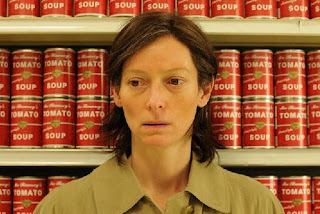 certainly the best of Swinton’s career. Her empathic delivery of one of the most difficult character arcs I have seen in some time is a testament to her extremely well refined talent as well as effective directing from Ramsey. Putting together this piece in such a commanding yet controlled manner allows Swinton’s underlying appreciation of Eva’s plight to shine through. The pair’s powerful chemistry is the glue in this amazingly well-assembled adaptation, truly making the experience of Kevin precious, if difficult at times.
 she should definitely have the young ingenue spot in the Lead Actress line-up at next year's Oscar ceremony.
 clearly has some lofty aspirations, trying to depict the creation of the world and then attempting to give a sort of pseudo-philosophical discourse on creationism and evolution and life and such. It is clearly a thing of beauty; the visuals are amazing, the sequence of shots depicting the Big Bang and the beginnings of the Earth and the solar system are incredible, the score behind it is awesome, and together they are powerful, if slightly prolonged. Even the later scenes in the suburban and city environments are, if nothing else, well shot.
 Seventh Sealstyle, which, although entirely pretentious, are almost fitting given that this film has pretty much been driving along on its last wheel for almost the entirety of its duration.